Islam Makhachev’s Sambo Comment Exposes a Real Problem in Modern Jiu-Jitsu
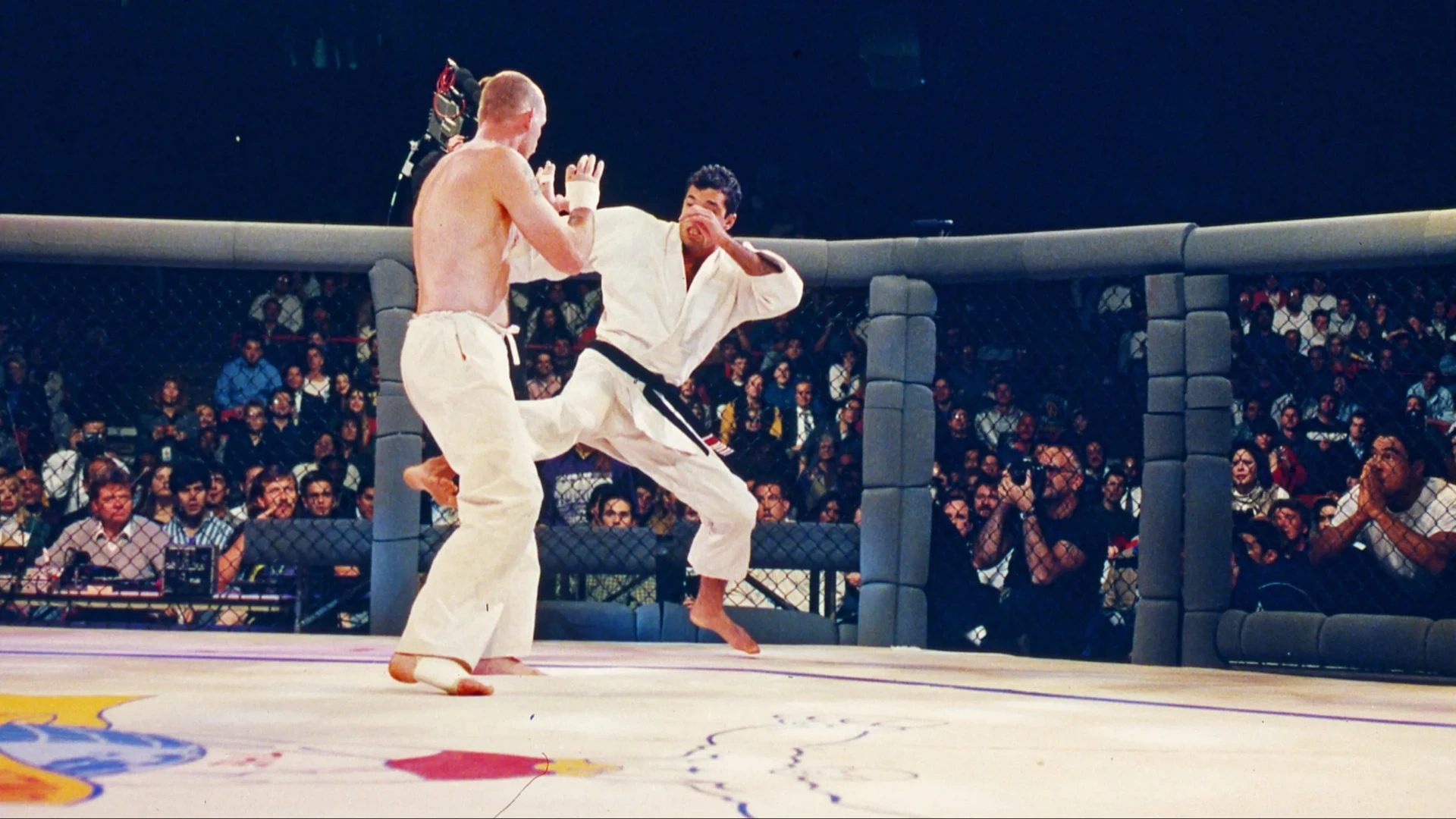
Sport jiu-jitsu inherited a reputation earned in fighting. Its separation from that purpose is already eroding that reputation and creating a false picture of jiu-jitsu as a whole.
At UFC 330 media day, Islam Makhachev argued that Sambo was superior for self-defense and pointed to the success of himself, Khabib Nurmagomedov and Fedor Emelianenko. Then came the line that drew attention:
“For example, jiu-jitsu, bro, if you want to defend yourself, you have to lay down. But Sambo, you can beginning from up.”
His criticism should not simply be dismissed, but it must be directed at the right target. Makhachev is describing what has become the overwhelmingly dominant expression of Brazilian jiu-jitsu: sport-oriented, no-strike grappling. Today, a prospective student searching for a Brazilian jiu-jitsu school is far more likely to find a program centered on tournament preparation than a fully structured self-defense jiu-jitsu curriculum. Self-defense jiu-jitsu has become exceptionally rare because preserving it requires a dedicated curriculum, not a few self-defense techniques added to sport classes. In our historical view, this narrowing was already underway in Brazil by the 1970s and accelerated sharply with the later worldwide popularization of BJJ tournaments.
There is an important irony here. The worldwide expansion of competitive jiu-jitsu was powered, in large part, by the reputation jiu-jitsu earned as perhaps the most effective martial art for real fighting. Challenge matches, vale tudo and the early UFC showed jiu-jitsu practitioners controlling and submitting opponents when strikes were part of the confrontation. Sport jiu-jitsu inherited credibility earned under broader conditions.
Over time, however, rules do more than determine who wins. They shape the art itself. A ruleset without punches, elbows or slams inevitably changes posture, distance, reactions and the positions athletes are encouraged to use. A prolonged turtle, seated guard or koala guard may be effective in a grappling match, but their risks change radically when an opponent can strike.
Elite competitors understandably devote most of their time to what their rules reward. Competitive success neither requires nor tests a complete self-defense curriculum. That is not a criticism of the athletes. It is an honest description of specialization.
The problem begins when that specialization continues to be presented as self-defense. The result is already visible: jiu-jitsu is increasingly caricatured as an art whose practitioners sit or lie down to fight while ignoring strikes. That image may resemble certain strategies rewarded in sport BJJ, but it is false when applied to jiu-jitsu as a whole. The reputational damage is no longer hypothetical.
What Prospective Students Should Ask
For anyone searching for adult jiu-jitsu classes, women’s self-defense, children’s jiu-jitsu or an anti-bullying program, the name “Brazilian jiu-jitsu” no longer reveals exactly what is being taught. They should ask whether self-defense is organized as a progressive curriculum and practiced regularly; whether training begins standing; whether punches and common attacks are addressed; and whether awareness, verbal boundaries, escape, weapons and multiple-attacker risks are included. An occasional demonstration or seminar is not the same as a self-defense curriculum.
That does not mean Sambo owns the idea of practical fighting. Sambo did not develop independently of jiu-jitsu. According to the International Sambo Federation, it was synthesized from Kodokan judo and Japanese jiu-jitsu together with numerous national wrestling and self-defense systems. Sambo and Brazilian jiu-jitsu therefore share part of the same technical ancestry.
History also resists simple rankings. Fedor’s career unquestionably demonstrates Sambo’s effectiveness. Yet in 2010, he was submitted from the guard in only 69 seconds by Brazilian jiu-jitsu black belt Fabrício Werdum with a triangle-armbar. That does not prove jiu-jitsu universally superior, just as Fedor’s victories do not prove the opposite. It shows that no system has a monopoly on effective technique.
Combat Sambo also remains a sport. It includes strikes and is more strike-aware than tournament BJJ, but its competition rules do not automatically teach awareness, de-escalation, weapons, multiple-attacker risk, legal judgment or escape. Those elements must be trained deliberately, whatever name appears above the academy door.
The neurological point is simple. Motor learning is specific to the cues, constraints and decisions repeatedly practiced. Startle is a rapid, brainstem-mediated response, not a tactical decision. Under pressure, the brain does not reliably add threats that live training has consistently excluded. This is why training both is not simply additive. Under sport constraints, reflexes are grooved for a context where strikes, weapons and multiple attackers do not exist — turning the back, jumping guard, conceding position for a submission. Those same reflexes can fire in a real confrontation and work directly against survival.
The jiu-jitsu Grandmaster Hélio Gracie taught us began standing and treated the ground as a possible phase of a confrontation, not its objective. It integrated awareness, striking, clinching, takedowns, control and escape around the purpose of personal defense. That is the method we have worked to preserve for more than 30 years while teaching civilians, law-enforcement professionals and military personnel.
Islam’s joke should be received as a warning, not a final judgment on jiu-jitsu. It reflects a perception that sport-oriented BJJ has helped create, but it becomes misleading when applied to jiu-jitsu as a whole. If he is describing sport-only BJJ, he has a point. If he is describing jiu-jitsu as jiu-jitsu for self-defense, he is not describing the art we learned or continue to teach.
The answer is not to defend every modern sporting habit. It is to remember what made the world believe in jiu-jitsu in the first place.
Hélio Gracie's son Royce lands a side kick on Gerard Gordeau during the final of UFC 1 in 1993 — the night jiu-jitsu proved its superiority. Note that jiu-jitsu possesses striking techniques when it is practiced as a complete fighting system, not as a sport for point tournaments.